
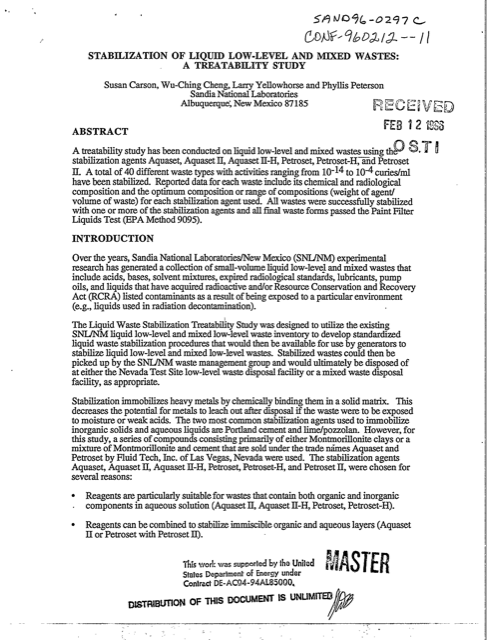
Independent, publicly released document. This study was prepared by Sandia National Laboratories under U.S. Department of Energy contract DE-AC04-94AL85000 and released for unlimited distribution. The summary below is provided for reference; the linked PDF and the official OSTI record are the authoritative sources.
01 Overview
02 Why this study matters
This is a national laboratory study rather than vendor literature. Sandia set out to develop standardized liquid-waste stabilization procedures from its own low-level and mixed-waste inventory, and selected the AQUASET / PETROSET agents to do it. For a generator evaluating solidification media, three points stand out:
- Breadth: ~40 real waste streams — acids, bases, solvent mixtures, pump oils, and radiological standards — not idealized lab surrogates.
- A clean pass rate: every stabilized form met the EPA Method 9095 Paint Filter Liquids Test, the regulatory free-liquids criterion for land disposal.
- Disposal-ready: wastes stabilized with PETROSET met the Waste Acceptance Criteria for disposal at the Nevada Test Site.
03 Stabilization agents evaluated
The study selected agents based primarily on montmorillonite clay, or a clay/cement blend, sold by Fluid Tech. Reasons cited include suitability for wastes containing both organic and inorganic components in aqueous solution, and the ability to combine agents to stabilize immiscible organic and aqueous layers.
| Agent | Noted role in the study |
|---|---|
| AQUASET II · AQUASET II-H | Wastes with both organic and inorganic components in aqueous solution. |
| PETROSET · PETROSET-H | Aqueous wastes with organic components; combinable with PETROSET II for immiscible layers. |
| PETROSET II | Specifically designed to stabilize waste oils, solvents, and other nonaqueous liquids. |
Unlike Portland cement, all agents except the "-H" (cement-containing) products set to final waste form in under 24 hours; the "-H" reagents set to the hardness of concrete in 2–4 days.
04 How the wastes were characterized
Generators completed a Process Knowledge Evaluation (PKE) for each waste to establish surface dose rate, total radionuclide activity, chemical constituents, and pH. Where data were unavailable or of questionable quality, samples were analyzed directly:
- A gamma spectrum was obtained for each waste to identify radionuclides and activity; tritium analysis was performed where tritium was known or suspected.
- Wastes suspected of being mixed were sent to an outside laboratory for toxic-metal, volatile-organic, and semivolatile-organic analysis.
- Only wastes below 100 mrem/hr at the container surface (and under 10 mrem/hr at one foot) were accepted, since the work was performed in a hood rather than a shielded glove box.
Most of the mixed low-level liquid inventory consisted of radiological standard solutions that were hazardous only because they were strongly acidic or basic; once neutralized, these became low-level wastes suitable for stabilization and disposal.
05 Authoritative sources
This page reproduces key points for accessibility and search. For citation, rely on the official records:
06 Citation
07 Related products
The agents evaluated in this study are part of Fluid Tech's current product line:
Publication, testing, or permitting by a government laboratory, contractor, or agency does not constitute endorsement of any commercial product.